Washington law requires the City of Roslyn to publish certain legal notices, ordinances, and hearing announcements in a designated “newspaper of record.” The City pays for that publication with tax dollars. If you then want to actually read that notice through the newspaper itself, and the newspaper’s website or print edition requires a paid subscription, you may be paying again, out of your own pocket, for something your taxes already funded once. This piece lays out how that system actually works in Roslyn, what it costs, and why the usual fallback, “just ask the City Clerk”, doesn’t really solve the problem for anything time-sensitive.
If you feel any information on this page is incorrect or out of date, please let us know — corrections are made promptly.
Update: October 25, 2026 — Added context comparing the resolution’s citation error to the City’s broader paperwork-accuracy history, including its 2018–2020 financial audit findings. See Update History at the bottom of this page.
How the Newspaper-of-Record System Works
Under RCW 35A.21.230, the City Council designates an official newspaper by resolution. That newspaper has to meet the qualifications in RCW 65.16.020: published at least weekly, general circulation, maintained an office at its place of publication, in business at least six months before being designated, and holding a periodical-class mailing permit. We cover the full legal framework, including how Roslyn’s specific classification as a noncharter code city affects this, on our Open Meetings & Public Records in Washington State page.
One detail worth being precise about: there is no newspaper published in Roslyn itself. The nearest one is in Cle Elum. That doesn’t disqualify it, state law only requires the designated paper to have general circulation in Roslyn, not to be physically printed there. But it does mean Roslyn residents are, by definition, relying on an outside publication for notice of their own City’s business.
The paper is the Northern Kittitas County Tribune (NKC Tribune), based in Cle Elum (807 W Davis St, Suite 101A), family-owned since 1953. The City Clerk confirmed this directly, and it’s documented in Resolution No. 25-001, adopted by the Roslyn City Council on January 14, 2025. The designation follows an annual bid process: the City emailed a Notice of Invitation to Bid to possible bidders on December 18, 2024, published that invitation on December 26, 2024, received one bid, from the NKC Tribune, and accepted it. Per the Clerk, the City will go out for bids again in November for the 2027 official newspaper.
Worth flagging: the resolution’s own citation appears to be the wrong one. Resolution 25-001 designates the Tribune “for the purpose of RCW 35.23.352(7),” the purchasing statute for second-class cities. We checked both subsections directly: subsection 7 only sets dollar thresholds for general purchases, it doesn’t mention newspapers at all. Subsection 8 is the one that actually requires annual bids for a newspaper of general circulation, a different subsection than the one cited. But Roslyn Municipal Code Chapter 1.20, itself codifying Ordinance 1022 (2007), states directly: “There is hereby adopted for the city of Roslyn, Washington, the classification of noncharter code city… governed according to Chapter 35A.12 RCW (Mayor-council plan of government).” That’s the City’s own current law, not our characterization of it. Roslyn has been a Title 35A noncharter code city since 2007, which makes RCW 35A.21.230, the code-city official-newspaper statute, the provision that actually appears to apply, not RCW 35.23.352. The most likely explanation is boilerplate language in the annual bid resolution that was never updated after the 2007 reorganization, not that the City’s newspaper designation itself is invalid, the underlying practice (soliciting bids, designating a paper by Council resolution) is consistent with either statute. But the specific citation in Resolution 25-001 appears to be the wrong one. (Resolution 25-001 itself isn’t posted at a public URL we could find, we have the document directly; happy to share a copy on request.)
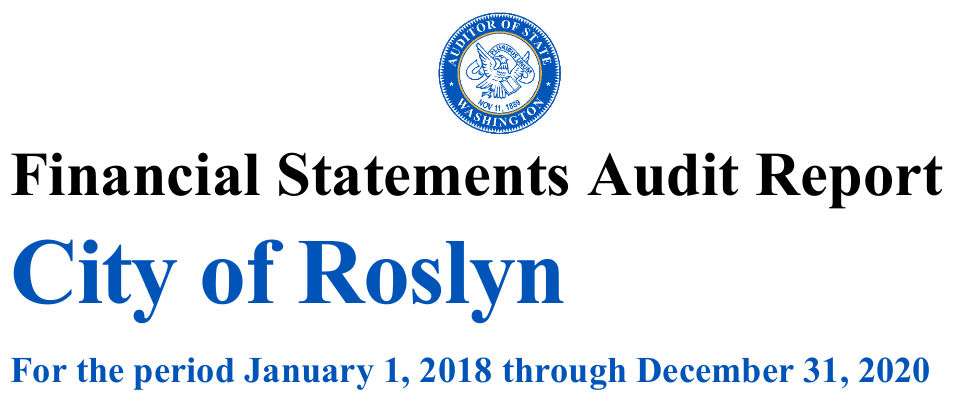
This isn’t the first time the City’s own paperwork hasn’t held up to a close read. In its 2018–2020 financial audit, the State Auditor’s Office found a “material weakness in internal controls,” including $533,680 in unrecorded logging revenue, over $3.5 million in misclassified cash and investments, and pension liabilities overstated by $49,396 in 2018 and $108,078 in 2020. The City attributed those findings to staff turnover and inadequate training, not bad faith. A wrong RCW citation in a boilerplate resolution isn’t in that league, there’s no dollar impact, and the underlying bid process was still valid, but it fits the same pattern: paperwork that doesn’t get a second look before it goes out the door.
The Tribune’s own bid materials describe its reach: an average total paid circulation of 2,300 (published Thursdays), with 1,900 of those copies purchased within Kittitas County, primarily Upper County, and a stated weekly readership of 4,750. Worth noting, that’s the Tribune’s own figure, submitted in a competitive bid to win the City’s business, not an independently audited number, and it’s a Kittitas County-wide figure, not a Roslyn-specific one. The Tribune’s bid letter also confirms that paid legal notices are posted free at wapublicnotices.com, independently corroborating what we found researching that site separately.
There’s a detail the Tribune’s self-reported, Kittitas County-wide circulation figures (2,300 total paid circulation, 1,900 purchased within the county, 4,750 stated weekly readers) don’t capture: how many Roslyn households specifically see the paper, or exactly how a copy gets to a Roslyn reader. Per the Tribune’s own bid letter, county copies reach readers through three channels: mail to subscribers, newsstand copies at local businesses, and street vending boxes.
Confirmed: Roslyn has no residential mail delivery. There are no home mailboxes and no carrier delivery routes here, all mail is picked up from a PO box at the Roslyn Post Office. What’s still unconfirmed is narrower: does the NKC Tribune run its own separate delivery system in Roslyn, dropping papers at homes, businesses, or vending boxes independent of the postal system, or does its distribution to Roslyn subscribers rely entirely on USPS mail delivered to PO boxes, the same as everything else here? The real test of “general circulation in the city” for Roslyn would be how many copies actually reach Roslyn readers each week, through whichever of those paths actually applies, a number we don’t have yet.
What This Actually Costs
The City pays the designated newspaper to run these notices. That’s a real, recurring taxpayer-funded expense. The City Clerk provided these totals directly:
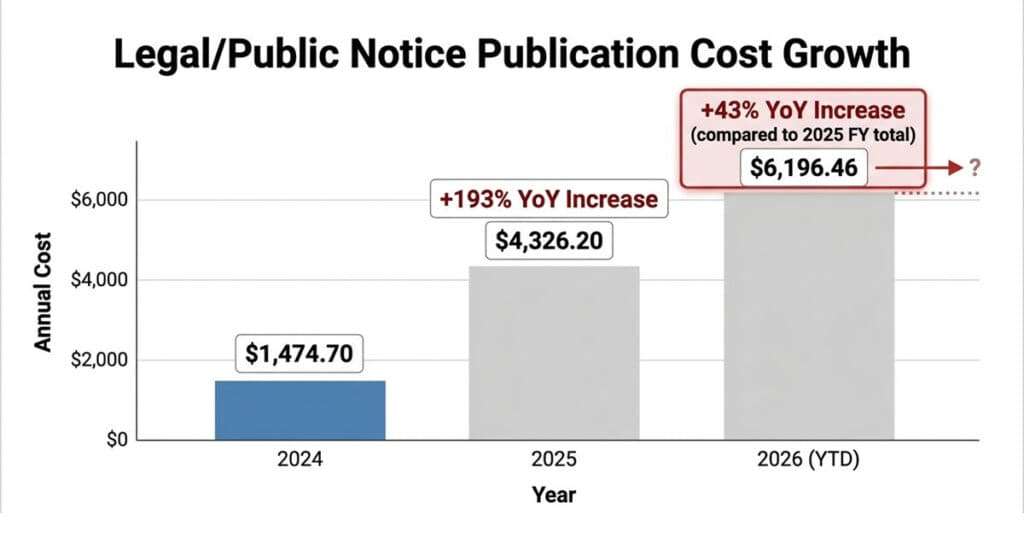
| Year | Legal/public notice publication cost | YoY increase |
|---|---|---|
| 2024 | $1,474.70 | — |
| 2025 | $4,326.20 | +193% |
| 2026 (year-to-date) | $6,196.46 | +43% (already past 2025’s full-year total, with 2026 not yet over) |
That’s a 193% jump from 2024 to 2025, and the 2026 year-to-date total has already passed all of 2025, with over two months still left in the year.
We didn’t ask why costs jumped, our question only asked for the dollar totals. The City Clerk volunteered an explanation anyway: “huge increase in 25-26 as the city has a lot more happenings.” No rate change, no new fee structure, just more notices being published. More City business requiring legal notice means more cost, and that unprompted explanation is the only one on the record for a cost that’s more than tripled since 2024.
For reference, the Tribune’s bid rate is $11.00 per column inch for a notice’s first insertion and $10.00 for repeat insertions of the same notice, discounted from its open commercial rate of $20.00 per column inch.
The Double-Payment Problem
Here’s the structural issue, stated plainly: the money that pays the newspaper doesn’t come from some anonymous government account, it comes out of the City’s general operating budget, which is funded primarily by property taxes paid by Roslyn property owners, along with other City-collected taxes and fees residents pay directly. That is the specific pool of money used to satisfy the City’s legal notice obligation. So when a Roslyn resident, the same person whose property tax payment helped fund that publication, then wants to read the notice through the newspaper’s own website or print edition, and that content sits behind a subscription paywall, they are being asked to personally pay a second time, out of their own pocket, for something their own tax payment already funded once.
To be precise about the legal picture: no one is technically required to pay to see the notice. A free, industry-run statewide compilation exists at wapublicnotices.com, and the underlying notice content is also a public record the City itself can provide on request. But in practice, the newspaper is the default, most visible channel the system is built around, and most residents have never heard of the free alternatives. For the overwhelming majority of people, the real-world effect is exactly what it looks like: tax dollars already paid to publish it, and the most natural, expected way to actually see it sits behind a subscription.
A Harder Case: Property Owners Who Don’t Live in Roslyn
The free workarounds above assume someone who can physically be in Roslyn, checking a PO box, a local newsstand, or a vending box, or who at least knows wapublicnotices.com exists. That assumption doesn’t hold for everyone the City’s notices actually affect. Someone who owns land or a house inside Roslyn city limits, but lives elsewhere, is still subject to City property taxes and still directly affected by things like a library levy vote, a utility rate increase, or a land use decision near their property. But they have none of the free, physically-local options available to them. For an owner like that, a paid, mailed subscription to the newspaper, sent to wherever they actually live, isn’t an inconvenience on top of a free option. It’s functionally the only realistic way they’d ever see the notice at all.
Put plainly: a non-resident property owner can be taxed on a City decision they had no practical way of finding out about, unless they’re already paying a newspaper, out of state if that’s where they live, specifically to watch for it.
Why “Just Ask the City Clerk” Doesn’t Fix This
The City Clerk can provide copies of past notices on request. That’s genuinely useful for research, after the fact. But it doesn’t solve the actual problem, because it’s reactive: you have to already know a notice exists before you can ask about it. Most public notices, comment periods, hearing dates, application deadlines, are time-sensitive. By the time you’d think to ask, “did the City publish anything relevant to this recently,” the comment period or hearing may already be over.
Being able to eventually obtain the text of a notice after the window to act on it has closed isn’t meaningful access, it’s a historical record. The entire point of a public notice requirement is to give people a real chance to participate before a decision is made, not just to prove, later, that a notice technically existed somewhere.
What Would Actually Fix This
Washington law already gives cities the tools to do better, without needing permission from the state. RCW 35A.12.160 lets a city satisfy its hearing-notice obligation through “another method that meets the statute’s purpose,” on top of, not instead of, the newspaper requirement. For SEPA actions specifically, WAC 197-11-510(1)(g) explicitly lists “mailing or emailing notice to any person, group or agency who has requested notice” as an acceptable method. Other Washington cities, Everett is one example, already maintain a standing email notification list residents can join by written request.
The fix isn’t complicated: a free or low-cost email list (a Google Group or Mailchimp’s free tier would cover it) that residents can opt into for City notices, supplementing, not replacing, the legally required newspaper publication. That would close the timeliness gap entirely, residents would know about a notice when it’s issued, not whenever they happen to think to ask.
Where This Stands
We’ve raised this directly with City staff. The response so far: current practice follows the code as written, and the City has noted limited staff capacity to maintain an additional notification list. Changing the actual notice procedure is a Council-level policy decision, not something staff can implement on their own. If you’d like to see this changed, raising it with the Roslyn City Council, in writing or during public comment at a Council meeting, is the step that actually moves it forward.
Sources
- City of Roslyn Resolution No. 25-001 (NKC Tribune designated official newspaper for 2025)
- RCW 35.23.352 (cited in Resolution 25-001; second-class city purchasing/bid procedures, appears to be an outdated citation, see below)
- Roslyn Municipal Code Chapter 1.20 (noncharter code city classification, codifying Ordinance 1022, 2007)
- City of Roslyn 2018–2020 Financial Audit Report (roselum.com)
- RCW 35A.21.230 (official newspaper designation, code cities)
- RCW 65.16.020 (legal newspaper qualifications)
- RCW 35A.12.160 (public notice of hearings, permitted methods)
- WAC 197-11-510(1)(g) (SEPA notice methods, including email on request)
- wapublicnotices.com
- Northern Kittitas County Tribune, 2025 Official Newspaper Bid letter to the City of Roslyn (Jan. 6, 2025)
- City of Roslyn Clerk, email correspondence (October 2026)
- Open Meetings & Public Records in Washington State (roselum.com)
Update History
October 25, 2026 – Published. Final fact-check and copyedit pass before launch, no substantive changes to figures or findings. Also added a short comparison to the City’s 2018–2020 financial audit findings, for context on how this citation error fits (and doesn’t fit) the City’s broader paperwork-accuracy history.
October 22, 2026 – Added confirmed cost figures (2024: $1,474.70; 2025: $4,326.20; 2026 YTD: $6,196.46), named the designated newspaper (Northern Kittitas County Tribune), and added detail on the annual bid process, all per the City Clerk’s reply and the underlying resolution and bid documents. Also confirmed Roslyn has no residential mail delivery (PO boxes only), added a section on non-resident property owners’ access gap, and, via the text of Roslyn Municipal Code Chapter 1.20, confirmed that Resolution 25-001’s citation to RCW 35.23.352 appears to be incorrect, RCW 35A.21.230 is the provision that actually applies to a noncharter code city like Roslyn.
October 16, 2026 – Page drafted, covering the newspaper-of-record legal framework, the double-payment structure, the timeliness gap in records-request access, and the proposed email-notification fix. Cost figures pending a response from the City Clerk.