Understanding the Roslyn, WA Historic District (and What It Means for Homeowners)
If you’ve spent time in Roslyn, Washington, you’ve probably noticed something unique: the town feels preserved in time. That’s not an accident. The Roslyn, WA historic district is officially recognized at the national, state, and local levels—covering much more than just its charming downtown.
This post breaks down what’s actually included in Roslyn’s historic registry and what that means for homeowners. For property owners, Washington’s historic district homeowner rules in Roslyn focus on exterior compatibility—not restricting your right to buy, sell, renovate interiors, or maintain your home.
If you feel any information on this page is incorrect or out of date, please let us know — corrections are made promptly.
Note:
NPS = official federal definition and program hub
NCSHPO = interpretive explanation emphasizing how the process works through state partners

National Archives Catalog – https://catalog.archives.gov/id/75612752
What Is the Roslyn Historic District?
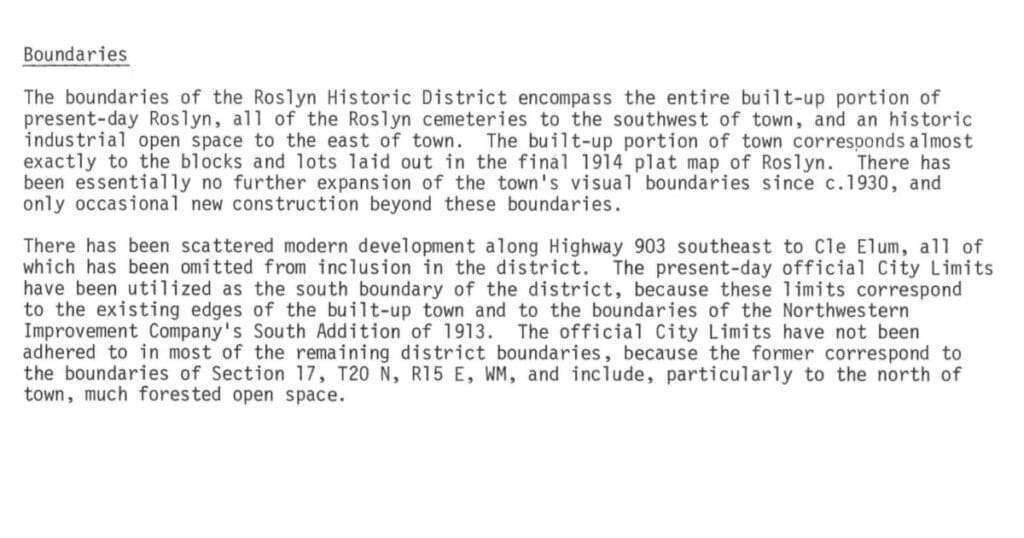
Roslyn is listed on the National Register of Historic Places as a Historic District — listed February 14, 1978 (NRHP reference #78002760) — recognizing it as one of the best-preserved coal mining towns in the United States. The listing covers the entire footprint of the city as it existed in 1914, per the City of Roslyn’s own Comprehensive Plan.
The historic district dates back to Roslyn’s founding in the late 1800s, when it was developed as a company town to support coal mining for the Northern Pacific Railroad.
Unlike some towns where only a few buildings are protected, Roslyn’s designation covers most of the original townsite, preserving its overall layout and character.
The nomination form — prepared by Florence K. Lentz in January 1977, ahead of the district’s February 1978 listing — includes a statement of significance that still holds up well: Roslyn’s importance rests on its role in Pacific Northwest coal mining history, the unusual diversity of its social structure (the nomination cites more than twenty nationalities represented in the town’s population), and a remarkable physical integrity — the built environment from roughly 1890 to 1930 remains largely intact because the town was never meaningfully expanded by later development.
What Areas and Buildings Are Included?
The district roughly follows the original town boundaries, including:
- Pennsylvania Avenue (the historic commercial core)
- Residential areas extending toward Utah Avenue and Montana Avenue — the original 1886 plat’s north and south boundary streets
- A cluster of 26 fraternal, ethnic, and public cemeteries on the west side of town — called out in the original 1978 nomination as “an important element of the historic district”
In total, the district includes:
- Around 900 lots
- Approximately 600 historic structures (homes, businesses, and civic buildings)
What Buildings and Areas Are Inside the Roslyn, WA Historic District?
The Roslyn, WA historic district encompasses approximately 900 lots and around 600 historic structures across the original townsite—spread across four main categories.
1. Downtown Commercial Core
Centered on Pennsylvania Avenue, this area features:
- Brick storefronts
- Historic bars, shops, and hotels
- One of the most intact small-town commercial streets in Washington
2. Residential Neighborhoods
Beyond downtown, most of the district consists of:
- Small wood-frame homes built between the 1890s and 1920s
- Modest “miner housing” and working-class cottages
- Grid-pattern streets climbing the hills around town
These neighborhoods are just as important historically as the downtown core—they tell the story of everyday life in a mining town.
3. Civic and Community Buildings
- Churches
- Library and former athletic club — the Old City Hall/Library Building was built in 1902 as the Roslyn Athletic Club, purchased by the City in 1918, and renovated beginning in 2005 through a citizen-led effort that expanded the library and converted the gymnasium into a community center
- Fraternal halls and schools
4. Industrial and Mining Sites
- Remnants of coal mining operations
- Structures like the Northwest Improvement Company building, which supported mining activity
- An approximately 58-acre historic industrial area on the flatlands east of town, site of two major mine disasters: an explosion at Mine #1 in 1892 killed all 45 miners in the mine at the time, and a 1909 explosion at Mine #4 (“The Shaft”) killed 10 miners
“Contributing” vs. “Non‑Contributing” Properties
Within the district, properties are typically classified as:
- Contributing:
Older buildings (generally pre‑1930s) that still retain their historic character - Non‑contributing:
Newer homes or heavily altered buildings
Most original homes in Roslyn’s residential neighborhoods fall into the contributing category, meaning they help define the town’s historic identity.
What the Historic Designation Means for Homeowners
One of the biggest misconceptions is that being in a historic district means you can’t change your house. That’s not true—but there are some important guidelines.
Can You Renovate a House in the Roslyn Historic District?
Yes—Washington’s historic district homeowner rules allow renovation in the Roslyn historic district with minimal restrictions. For most homeowners, you can:
- Buy, sell, or rent your property
- Remodel or update interiors
- Maintain and repair your home
Simply being on the National Register does not restrict private property owners by itself.
What Requires Review
Because Roslyn also has a local design review process, certain exterior changes usually require approval. Most homeowners go through a staff-level review under the city’s Architectural Design Standards (RMC 18.50). Properties individually listed on the Roslyn Register of Historic Places go through a more detailed review by the Planning and Historic Preservation Commission under RMC 18.60 — and may also qualify for a state property-tax break on qualifying rehabilitation work (RCW 84.26). Examples of exterior changes that typically require review:
- Replacing windows or siding
- Altering the roof or building form
- Adding visible additions or new structures
These changes are reviewed to ensure they remain compatible with the town’s historic look and feel.
New Construction and Additions
If you build or expand:
- The design must fit the scale and character of surrounding historic homes
- Modern designs are allowed, but they must be visually compatible
Demolition Rules
Demolishing older, contributing buildings is typically:
- Heavily discouraged
- Subject to review or delays
This helps preserve the overall integrity of the district.
Financial Pros and Cons
Potential Benefits
- Access to historic tax incentives for qualified renovations
- Increased property value tied to historic character
- Strong appeal for tourism, rentals, and second homes
Qualifying renovation projects may be eligible for a 20% federal Historic Tax Credit (IRS Form 3468)—making improvements in the Roslyn, WA historic district a potential financial opportunity beyond property value gains.
Possible Trade-Offs
- Exterior renovations may cost more (due to materials or approvals)
- Projects can take longer due to review processes
The Bottom Line
Roslyn’s historic designation is unique because it preserves an entire town—not just a handful of landmarks.
For Roslyn, WA historic district homeowners, the rules mean interior renovations, sales, and rentals are unrestricted—only exterior changes require review by the local Historic Preservation Commission.
For homeowners, that means:
- You retain normal ownership rights
- Exterior changes are guided—not prohibited
- You’re part of preserving one of Washington’s most distinctive historic communities
Ultimately, the designation is less about restriction and more about stewardship—maintaining the character that makes Roslyn special.
If you’re considering buying or renovating in Roslyn, understanding these guidelines upfront can help you make smarter decisions—and appreciate the history you’re becoming part of.